
Who Is Man?
A Biblical Understanding of Humanity and Sin
One of the most profound questions human beings have ever asked is simple yet deeply complex: Who is man?
Philosophers, scientists, and theologians have wrestled with this question for centuries. Are human beings merely physical bodies? Are we ideas, relationships, or products of evolution? Or are we something more?
While philosophy offers many opinions, Scripture provides the most authoritative and complete answer. The Bible does not only explain where humanity comes from—it reveals who we are, why we are broken, and what that brokenness means. This article explores the biblical doctrine of humanity and sin in a way that is clear, grounded, and accessible to all readers.
Competing Views About the Nature of Man
Throughout history, several views have attempted to define human nature:
-
Materialism: Man is only a physical body.
-
Idealism: The body is merely an idea; reality is mental.
-
Pragmatism: We know neither material nor immaterial reality, only relationships.
-
Creationism: Man is a direct creation of God.
While these views explain what people think about humanity, only the Bible explains what humanity truly is. Scripture answers the question “Who is man?” not by speculation, but by divine revelation.
Man Is a Created Being
The Bible begins humanity’s story with God’s creative act (Genesis 1:20–2:9). Human beings are not accidents of nature or products of blind processes. Man is deliberately created by God.
Several truths stand out:
-
Humans are part of creation, yet occupy a unique place within it
-
Humanity is not an emanation from God’s being, but a distinct created order
-
The human race did not arise through independent natural processes, but through God’s direct creative act
-
Genesis 1 repeatedly emphasizes God as Creator—seventeen times He is explicitly named as such
-
Genesis 1:1 teaches creation out of nothing (ex nihilo); no pre-existing material is implied
Also Read The Authority of Scripture: Why Christians Should Pray Using the Scripture
A Brief Word on Evolution
Even if evolution could explain survival, it cannot explain origin. It offers no satisfactory answer to where the first life came from. Scripture affirms that God formed man directly (Genesis 2:7), and attempts to read evolutionary theory into this passage lead to theological and logical contradictions.
Man as a Multifaceted Being
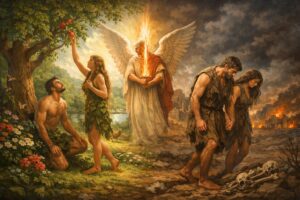 According to Scripture, man is both material and immaterial:
-
Body (material)
-
Soul / Spirit (immaterial)
Both aspects are the direct result of God’s creative work (Genesis 2:7). Humanity is not merely physical, nor merely spiritual—we are a unified whole.
Man Created in the Image of God
One of the most important truths about humanity is found in Genesis 1:26–27:
Man is created in the image and likeness of God.
This does not mean physical resemblance. Rather, the image of God refers to:
-
Personality
-
Moral awareness
-
Rationality
-
Relational capacity
-
Original moral uprightness
Although the Fall marred this image, it was not erased (1 Corinthians 11:7; James 3:9). This truth gives every human being dignity, value, and responsibility before God.
The Nature of Man: Body, Soul, and Spirit
Scripture uses several terms to describe human nature:
-
Body (soma)
-
Soul (psyche)
-
Spirit (pneuma)
-
Flesh (sarx)
This has led to different views:
-
Dichotomy: Man consists of body and soul/spirit
-
Trichotomy: Man consists of body, soul, and spirit
-
Unity view: Man is a psychosomatic unity
The Bible often uses “soul” to refer to the whole person (Matthew 6:26; Acts 27:37). The emphasis of Scripture is not on dividing man into parts, but on viewing humanity as a unified being created by God.
Also Read Who Is God? A Biblical and Christian Understanding
The Origin of the Soul
Three main views have been proposed:
- Pre-existence theory – Souls existed before the body (no biblical support)
- Creation theory – God directly creates each soul (Genesis 2:7; Ecclesiastes 12:7)
- Traducian theory – Soul and body are both inherited from Adam (Acts 17:26)
While Christians differ on this issue, Scripture is clear that human life is ultimately God-given and God-governed.
The Fall of Man: How Sin Entered the World
Genesis 3 explains how sin entered human experience. While the mystery of why God allowed sin remains unanswered, the means by which sin entered is clearly revealed.
At the heart of the temptation was rebellion:
“You will be like God” (Genesis 3:5).
Sin was not merely disobedience—it was an attempt to replace God.
What Is Sin?
Biblically, sin is defined as missing the mark (Hebrew chattah, Greek hamartia). It includes failure, wrongdoing, and moral rebellion. Another key term, adikia, refers to unrighteousness or injustice.
Most importantly, sin is directed against God (Psalm 51:4). Any definition of sin that minimizes this reality underestimates its seriousness.
Key Biblical Truths About Sin
-
Sin is moral evil, not physical calamity
-
Sin violates God’s law, not merely human conscience
-
Sin includes both omission and commission
-
Sin is both an act and a nature
-
Sin produces guilt and pollution
-
At its core, sin is selfishness
The Extent of Human Sinfulness
Scripture teaches that sin is:
Universal
“There is no one righteous, not even one” (Romans 3:10).
Total
Sin affects every part of human nature—mind, will, emotions, and desires. This is often called total depravity, meaning not that humans are as evil as possible, but that every aspect of human life is touched by sin.
Inherited
Adam’s sin is imputed to the entire human race (Romans 5:12–19). Humanity is born with a sinful nature and under divine condemnation apart from grace.
The Effects of Sin
In Relation to God
-
Separation from God’s presence
-
Enslavement to sin
-
Condemnation under God’s law
In Relation to Others and Self
-
Conflict and violence (Genesis 4)
-
Shame, fear, and self-deception
-
Restlessness and inner turmoil
In Relation to Creation
Human sin results in exploitation and pollution of the environment, distorting God’s original design.
Conclusion: Who Is Man?
According to Scripture, man is:
-
A created being
-
Made in the image of God
-
A unified person, body and soul
-
Fallen through sin
-
Universally sinful and morally responsible before God
Understanding who man is helps us understand why the gospel is necessary. The doctrine of humanity and sin (Who is Man) does not end in despair—it prepares the way for redemption.